Showing posts with label Renewable Energy. Show all posts
Showing posts with label Renewable Energy. Show all posts

Australia To Pioneer Off-Grid Solar Power Storage With SunPower
CAMPBELL SIMPSON
Australia will be one of the proving grounds for the world’s second largest solar energy company to test its off-grid solar energy storage, putting solar panels and lithium-ion batteries into customers’ homes in Victoria. SunPower is expected to make an official announcement on a pilot project in Australia’s second most populous state in the next two months.
According to the ABC, SunPower is planning to use Australia to test a combination of rooftop photovoltaic (PV) panels and battery storage, giving houses off-the-grid electricity access during the daytime and during clear, sunny weather conditions with sufficient storage capacity to power applicances for extended periods of poor sunlight and during nighttime (Read More...... http://www.gizmodo.com.au/2014/05/australia-to-pioneer-off-grid-solar-power-storage-with-sunpower/
Solar Cooking and Food Drying and Solar Stills and Root Cellars
http://www.builditsolar.com/Projects/Cooking/cooking.htm#Bill
UN Panel: Renewables, Not Nukes, Can Solve Climate Crisis
By Harvey Wasserman on Apr 16, 2014
The authoritative Intergovernmental Panel on Climate Change has left zero doubt that we humans are wrecking our climate.
It also effectively says the problem can be solved, and that renewable energy is the way to do it, and that nuclear power is not.
The United Nations’ IPCC is the world’s most respected authority on climate.UN Panel: Renewables, Not Nukes, Can Solve Climate Crisis
Renewable Energy No Nuclear- An Environmental Engineer’s 2030 Forecast
May 16, 2013
In this month’s Report on Business Magazine, a supplement that comes with The Globe and Mail, one of Canada’s national newspapers, Stanford University’s Mark Jacobson provides a best case scenario for powering our planet in the year 2030. A civil and environmental engineer, Jacobson statesthat the only thing impeding this outcome is“lobbyists and special interest groups, particularly from the energy companies that would stand to lose from a conversion.”

Jacobson’s energy mix includes wind, concentrated solar (molten salt heated by solar mirrors), photovoltaics, geothermal, tidal and wave, and hydroelectricity. No coal fired power plants. No natural gas plants. and no nuclear. (read more..... http://www.21stcentech.com/energy-update-environmental-engineers-2030-forecast/
In this month’s Report on Business Magazine, a supplement that comes with The Globe and Mail, one of Canada’s national newspapers, Stanford University’s Mark Jacobson provides a best case scenario for powering our planet in the year 2030. A civil and environmental engineer, Jacobson statesthat the only thing impeding this outcome is“lobbyists and special interest groups, particularly from the energy companies that would stand to lose from a conversion.”
Jacobson’s energy mix includes wind, concentrated solar (molten salt heated by solar mirrors), photovoltaics, geothermal, tidal and wave, and hydroelectricity. No coal fired power plants. No natural gas plants. and no nuclear. (read more..... http://www.21stcentech.com/energy-update-environmental-engineers-2030-forecast/
Clean energy from an inexhaustible source
25 november 2010
Energy transmission by laser – the solution for the Earth’s future energy supply?
The
issue of global warming is of concern to all. Reduction of energy
consumption is an important factor but still it will not bring the
additional energy needed for developing populations without increasing
the effect of global warming.
The root cause of this warming effect is that, in the conversion to electricity, all of our current energy sources release around 50% in heat into the atmosphere plus some greenhouse gases and other unwanted particulates. The quest to find a long-term solution to providing power which does not increase the heat and gas rejected in the atmosphere is becoming urgent.

The solution Astrium has come up with is to extract energy from the solar flux available around the Earth and convert it in space into a beam of infra-red energy pointed to a highly efficient receiver. The key difference here is that the conversion losses from solar flux to infra-red beam (25% multispectral solar cell efficiency and 50% efficiency in conversion to laser) would be dissipated in space and therefore would not affect the Earth.
In terms of impact on the environment, therefore, only the conversion from light to electricity (the best for narrow band photovoltaics is currently around 50%, but could be up to 80% in the future) needs be considered.
What about the safety of high energy beams?
We have selected energy transmission at an infra-red wavelength of 1.5 microns because at that wavelength we can transmit up to 1,000 W/m² to ground safely. This is comparable with normal sunlight at 1,300 W/m² with no dust or atmospheric losses. A human passing through such a beam would receive as much heat as if he were exposed directly to the sun, but without the secondary effects of UV contained in the sunlight. Any other object or animal would also be able to safely cross the 1.5 micron beam.
Original http://www.astrium.eads.net/en/articles/clean-energy-from-an-inexhaustible-source.html
The root cause of this warming effect is that, in the conversion to electricity, all of our current energy sources release around 50% in heat into the atmosphere plus some greenhouse gases and other unwanted particulates. The quest to find a long-term solution to providing power which does not increase the heat and gas rejected in the atmosphere is becoming urgent.
The solution Astrium has come up with is to extract energy from the solar flux available around the Earth and convert it in space into a beam of infra-red energy pointed to a highly efficient receiver. The key difference here is that the conversion losses from solar flux to infra-red beam (25% multispectral solar cell efficiency and 50% efficiency in conversion to laser) would be dissipated in space and therefore would not affect the Earth.
In terms of impact on the environment, therefore, only the conversion from light to electricity (the best for narrow band photovoltaics is currently around 50%, but could be up to 80% in the future) needs be considered.
What about the safety of high energy beams?
We have selected energy transmission at an infra-red wavelength of 1.5 microns because at that wavelength we can transmit up to 1,000 W/m² to ground safely. This is comparable with normal sunlight at 1,300 W/m² with no dust or atmospheric losses. A human passing through such a beam would receive as much heat as if he were exposed directly to the sun, but without the secondary effects of UV contained in the sunlight. Any other object or animal would also be able to safely cross the 1.5 micron beam.
Original http://www.astrium.eads.net/en/articles/clean-energy-from-an-inexhaustible-source.html
Russian electric car hits assembly line
Aug 24, 2012 15:59 Moscow Time
|
|


AvtoVaz. Photo: RIA Novosti
|
The Russian AvtoVAZ car makers have started assembling electric cars at their plant in Togliatti on the Middle Volga River.
The El Lada vehicle can travel
150km on a single charge at speeds of up to 130km an hour. Recharging
its batteries takes 8 hours.
The car is to be shown off at the next Moscow Motor Show, which is opening next week.
The car is to be shown off at the next Moscow Motor Show, which is opening next week.
The first batch of El Ladas will go to taxi operators in the Russian Caucasus. (original The Voice of RussiaTASS
| Мне нравится |
------------------------------------------------------------------
Electric transport to develop in Russian south
Apr 26, 2012 22:03 Moscow Time
|
|

Photo: EPA
|
Electric vehicles are the most popular exhibits at the 9th International Forum Investment in Human Capital in Kislovodsk (Stavropol Region in the south of Russia).
Among
the exhibits are an electric bicycle, a scooter, a cargo tricycle, a
Lada Ellada hatchback designed on the basis of the Russian Lada Kalina
car, and a Mitsubishi I Miev minicar of an amazing futuristic design and
space-silvery colour.
The head of the Mitsubishi
electric vehicle project Sergey Sobolev says that the Stavropol Region
and the Caucasian Mineral Waters area in particular are interesting to
electric car manufacturers because the warm climate allows to take full
advantage of the accumulator performance. (original THE VOICE OF RUSSIA)
Related articles


(original THE VOICE OF RUSSIA)
Tidal Stream Generator
From Wikipedia, the free encyclopedia

 Tidal stream generators are the cheapest and the least ecologically damaging among the three main forms of tidal power generation.[2]
Similarity to wind turbines
Tidal stream generators draw energy from water currents in much the same way as wind turbines
draw energy from air currents. However, the potential for power
generation by an individual tidal turbine can be greater than that of
similarly rated wind energy turbine. The higher density of water
relative to air (water is about 800 times the density of air) means that
a single generator can provide significant power at low tidal flow
velocities compared with similar wind speed.[3]
Given that power varies with the density of medium and the cube of
velocity, it is simple to see that water speeds of nearly one-tenth of
the speed of wind provide the same power for the same size of turbine
system; however this limits the application in practice to places where
the tide moves at speeds of at least 2 knots (1 m/s) even close to neap tides.
Furthermore, at higher speeds in a flow between 2 to 3 metres per
second in seawater a tidal turbine can typically access four times as
much energy per rotor swept area as a similarly rated power wind
turbine.
Types of tidal stream generators
Since tidal stream generators are an immature technology, no standard
technology has yet emerged as the clear winner, but a large variety of
designs are being experimented with, some very close to large scale
deployment. Several prototypes have shown promise with many companies
making bold claims, some of which are yet to be independently verified,
but they have not operated commercially for extended periods to
establish performances and rates of return on investments.
The European Marine Energy Centre[4] categorises them under four heads although a number of other approaches are also being tried.
Axial turbines

These are close in concept to traditional windmills operating under
the sea and have the most prototypes currently operating. These include:
The AR-1000, a 1MW tidal turbine developed by Atlantis Resources
Corporation which was successfully deployed and commissioned at the EMEC
facility during the summer of 2011. The AR series turbines are
commercial scale Horizontal Axis Turbines designed for open ocean
deployment in the harshest environments on the planet. AR turbines
feature a single rotor set with highly efficient fixed pitch blades. The
AR turbine is rotated as required with each tidal exchange. This is
done in the slack period between tides and fixed in place for the
optimal heading for the next tide. AR turbines are rated at 1MW @
2.65m/s of water flow velocity.
Kvalsund, south of Hammerfest, Norway. Although still a prototype, a turbine with a reported capacity of 300 kW was connected to the grid on 13 November 2003.
A 300 kW Periodflow marine current propeller type turbine — Seaflow — was installed by Marine Current Turbines off the coast of Lynmouth, Devon, England, in 2003.
The 11m diameter turbine generator was fitted to a steel pile which was
driven into the seabed. As a prototype, it was connected to a dump
load, not to the grid.
Since April 2007 Verdant Power has been running a prototype project in the East River between Queens and Roosevelt Island in New York City; it was the first major tidal-power project in the United States.[8]
The strong currents pose challenges to the design: the blades of the
2006 and 2007 prototypes broke off, and new reinforced turbines were
installed in September 2008.
Following the Seaflow trial, a full-size prototype, called SeaGen,
was installed by Marine Current Turbines in Strangford Lough in
Northern Ireland in April 2008. The turbine began to generate at full
power of just over 1.2 MW in December 2008 and is reported to have fed 150 kW into the grid for the first time on
17 July 2008, and has now contributed more than a gigawatt hour to
consumers in Northern Ireland. It is currently the only commercial scale device to have been installed anywhere in the world.
SeaGen is made up of two axial flow rotors, each of which drive a
generator. The turbines are capable of generating electricity on both
the ebb and flood tides because the rotor blades can pitch through 180˚.
OpenHydro, an Irish company exploiting the Open-Centre Turbine developed in the U.S., has a prototype being tested at the European Marine Energy Centre (EMEC), in Orkney, Scotland.
A prototype semi-submerged floating tethered tidal turbine called Evopod has been tested since June 2008[ in Strangford Lough, Northern Ireland at 1/10 scale. The company developing it is called Ocean Flow Energy Ltd, and they are based in the UK.
The advanced hull form maintains optimum heading into the tidal stream
and it is designed to operate in the peak flow of the water column.
Tenax Energy of Australia is proposing to put 450 turbines off the coast of the Australian city Darwin, in the Clarence Strait.
The turbines feature a rotor section that is approximately 15 metres in
diameter with a gravity base which is slighter larger than this to
support the structure. The turbines will operate in deep water well
below shipping channels. Each turbine is forecast to produce energy for
between 300 and 400 homes.
Tidalstream, a UK-based company, has commissioned a
scaled-down Triton 3 turbine in the Thames, see picture on the right,
and photographs maintained on their website.
It can be floated out to site, installed without cranes, jack-ups or
divers, and then ballasted into operating position. At full scale the
Triton 3 in 30-50m deep water has a 3MW capacity, and the Triton 6 in
60-80m water has a capacity of up to 10MW, depending on the flow. Both
platforms have man-access capability both in the operating position and
in the float-out maintenance position. http://en.wikipedia.org/wiki/Space-based_solar_power
..........
Potential sites
As with wind power, selection of location is critical for the tidal
turbine. Tidal stream systems need to be located in areas with fast
currents where natural flows are concentrated between obstructions, for
example at the entrances to bays and rivers, around rocky points,
headlands, or between islands or other land masses. The following
potential sites are under serious consideration:
- Pembrokeshire in Wales
- River Severn between Wales and England
- Cook Strait in New Zealand
- Kaipara Harbour in New Zealand
- Bay of Fundy[45] in Canada.
- East River[46][47] in the USA
- Golden Gate in the San Francisco Bay
- Piscataqua River in New Hampshire
- The Race of Alderney and The Swinge in the Channel Islands
- The Sound of Islay, between Islay and Jura in Scotland
- Pentland Firth between Caithness and the Orkney Islands, Scotland
- Humboldt County, California in the United States
- Columbia River, Oregon in the United States
- Taiwan in the East Coast
Modern advances in turbine
technology may eventually see large amounts of power generated from the
ocean, especially tidal currents using the tidal stream designs but
also from the major thermal current systems such as the Gulf Stream, which is covered by the more general term marine current power.
Tidal stream turbines may be arrayed in high-velocity areas where
natural tidal current flows are concentrated such as the west and east
coasts of Canada, the Strait of Gibraltar, the Bosporus, and numerous sites in Southeast Asia
and Australia. Such flows occur almost anywhere where there are
entrances to bays and rivers, or between land masses where water
currents are concentrated.
Environmental impacts
Very little direct research or observation of tidal stream systems
exists. Most direct observations consist of releasing tagged fish
upstream of the device(s) and direct observation of mortality or impact
on the fish.
One study of the Roosevelt Island Tidal Energy (RITE, Verdant Power)
project in the East River (New York City), utilized 24 split beam
hydroacoustic sensors (scientific echosounder)
to detect and track the movement of fish both upstream and downstream
of each of six turbines. The results suggested (1) very few fish using
this portion of the river, (2) those fish which did use this area were
not using the portion of the river which would subject them to blade
strikes, and (3) no evidence of fish traveling through blade areas.
Work is currently being conducted by the Northwest National Marine Renewable Energy Center (NNMREC )to
explore and establish tools and protocols for assessment of physical
and biological conditions and monitor environmental changes associated
with tidal energy development. (Original.....http://en.wikipedia.org/wiki/Space-based_solar_power
Solar Powered Toilet
Caltech Team Develops Solar Powered Toilet

This might be the last place you'd expect solar power to change your life. | Photo: Epsos.de/Flickr/Creative Commons License
More than two and a half billion people on the planet lack access to
sanitary facilities, and the resulting contamination of drinking water
is responsible for one of the leading causes of deaths among the worlds
infants and children. But a team of Caltech engineers, with funding from
Bill and Melinda Gates, may have a partial solution to the problem --
and the whole thing runs on solar power.
Dehydration from diarrhea is the second
largest cause of global infant mortality, after respiratory ailments,
and 88% of life-threatening diarrhea worldwide is caused by drinking
contaminated water. A child somewhere in the world dies from drinking
impure water every 30 seconds.
In the developed world we can go about our bodily functions without
thinking: we have fresh water piped into our (often wasteful) flush
toilets, which then take the resulting waste away so that it can,
theoretically, be treated and made less harmful. Though our system is
far from perfect, and has significant pollution effects of its own, it
has made possible a revolution in public health: hardly anyone in the
industrial world dies of waterborne diseases anymore.
But much of the world has access to neither fresh water nor a safe
sewage system, and the Bill and Melinda Gates Foundation, through its "Reinventing the Toilet"
program, is trying to create off-the-grid ways for people to answer the
Call of Nature without polluting that nature, or their neighbors'
drinking water. The Gates Foundation has raised an engineering
challenge: can we build a toilet that doesn't require a sewer hookup, a
water source, or grid power, and costs five cents a day or less to
operate, but which doesn't pollute the air or water?
A team from Caltech just won a challenge held as part of that
campaign with its solar-powered toilet. Engineer MIchael Hoffman and his
colleagues took their design to the Gates Foundations' "Reinvent the
Toilet Fair," held this week in Seattle, and walked away with the
$100,000 prize for the best design.
The Caltech design uses a photovoltaic panel to generate energy,
stored in batteries, to power an electrostatic unit that purifies
liquids drawn from a small septic tank. The unit produces hydrogen as it
cleans the water, potentially a supplementary source of toilet power on
cloudy days or at night. The unit also purifies the solid waste which
can then be used as biofuel or fertilizer. (Keep reading...
Connecticut's nuclear power plant shut one of two units on Sunday because seawater used to cool down the plant is too warm.
 | |||||||||
The
nuclear Millstone Power Station in Waterford, Conn., has been partially
shut down because the seawater used to cool key components is too warm
following a mild winter and the hottest July on record. Associated Press
filePublished: 8/14/2012 2:26 AMLast Modified: 8/14/2012 6:16 AMHARTFORD, Conn. - Connecticut's nuclear power plant shut one of two units on Sunday because seawater used to cool down the plant is too warm.
Unit 2 of Millstone Power Station has occasionally shut for maintenance
or other issues, but in its 37-year history it has never gone down due
to excessively warm water, spokesman Ken Holt said on Monday.
Water from Long Island Sound is used to cool key components of the plant and is discharged back into the sound. The water cannot be warmer than 75 degrees and following the hottest July on record has been averaging 1.7 degrees above the limit, the Nuclear Regulatory Commission said. The federal agency issued an "emergency license amendment" last week, allowing Millstone, a subsidiary of Dominion Resources Inc., to use an average temperature of several readings. "It wasn't enough to prevent us from shutting down," Holt said. In addition to the extreme heat last month, the mild winter didn't help because it kept Long Island Sound water unusually mild, Holt said. Robert Wilson, a professor at Stony Brook University's School of Marine and Atmospheric Sciences, said readings show temperatures in central Long Island Sound are nearly 80 degrees, much higher than the more typical 74 degrees. He blamed weather patterns, beginning with the mild winter and little wind that allows heat to hang around. "If you start from warm winters, then have sustained persistent surface heating without wind stirring, you get very high temperatures," Wilson said. Millstone provides half of all power used in Connecticut and 12 percent in New England. Its two units produce 2,100 megawatts of electricity, which is reduced by 40 percent with Unit 2 down, Holt said. Richmond, Va.-based Dominion, which operates Millstone, does not have an estimate of when the unit will restart, he said. Marcia Blomberg, a spokeswoman for regional grid operator ISO-New England, said the loss of electricity will not be a major problem. The Holyoke, Mass.-based agency generally operates with a margin of reserve and plans for the possibility of lost resources, she said. "Generators are big machines," she said. "It happens frequently that resources are unable to start up or have to power down." Dave Lochbaum, director of the Union of Concerned Scientists' nuclear safety project, said he believes the partial Millstone shutdown is the first involving a nuclear plant pulling water from an open body of water. A few nuclear plants that draw water from inland sources have powered down due to excessively warm water, he said. Browns Ferry nuclear plant in Alabama, for example, reduced power for 50 days in the summer of 2010 and fewer than 10 days last year, said Ray Golden, spokesman for the Tennessee Valley Authority, which operates the plant. No power reductions were needed this year because the plant cools the water, he said. Krista Lopykinski, a spokeswoman for Exelon Corp., which operates six nuclear plants in Illinois, said seeking state authorization to operate at an unchanged or higher level in response to elevated lake and river temperatures is "pretty common." "It happens every summer," she said. Original Tulsa World |
|
“Evacuation order… for fear of potential radiation” in Louisiana parish — Company Official: Sinkhole ‘could still grow’
ABC: “Evacuation order… for fear of potential radiation” in Louisiana parish — Company Official: Sinkhole ‘could still grow’
 By CHRISTINA NG | ABC News – 11 hrs ago
 |
| http://l.yimg.com/bt/api/res/1.2/doHeBO_YOdkJKUI2UMABMA--/YXBwaWQ9eW5ld3M7Y2g9MzU1O2NyPTE7Y3c9NjMwO2R4PTA7ZHk9MDtmaT11bGNyb3A7aD0zNTU7cT04NTt3PTYzMA--/http://l.yimg.com/os/152/2012/08/14/sinkhole-jpg_140120.jpg |
A nearly 400-foot deep sinkhole in Louisiana has swallowed all of the
trees in its area and enacted a mandatory evacuation order for about 150
residences for fear of potential radiation and explosions.
The 400-square-foot gaping hole is in Assumption Parish, La., about 50 miles south of Baton Rouge.
The sinkhole sits
in the middle of a heavily wooded space where it has consumed all of the
soaring cypress trees that had been there. Flyover photos show some of
the treetops still visible through the mud.
Authorities enacted a mandatory evacuation for between 100 and150 homes
in the area, but most people have chosen to stay, according to the
Mayor's Office of Emergency Preparedness. If any of the dangers seem to
become more imminent, the order will be escalated to a forced
evacuation.
While officials are not certain what caused the massive sinkhole, they
believe it may be have ben caused by a nearby salt cavern owned by the
Texas Brine Company.
After being used for nearly 30 years, the cavern was plugged in 2011 and
officials believe the integrity of the cavern may have somehow been
compromised, leading to the sinkhole.
[Slideshow: Massive sinkholes wreak havoc around the world]
On Thursday, Louisiana's Department of Natural Resources required that
Texas Brine drill a well to investigate the salt cavern as soon as
possible, obtain samples from the cavern and provide daily reports on
their findings.
It could take up to 10 days to set up the drilling process, even with an
expedited process.
"We have to arrange for the driller. We have to pick a location. We have
to be very careful to not be in a point that's too close to the
sinkhole because of the weight of the rig," Texas Brine Company
spokesman Sonny Cranch told ABCNews.com today. "We don't want to
aggravate the situation."
The sinkhole is on the outside edge of the salt dome where this particular brine well is located.
"There are some indications that it very well may have been connected,
but there's just indications," Cranch said. "There's nothing concrete
that has connected the sinkhole to the cavern."
There was bubbling in the water and the sinkhole is near areas where
there has been exploration for oil and gas in the past, which would make
the presence of low levels of naturally occurring radioactive material
(NORM) possible.
The state's Department of Environmental Quality said water samples from
the sinkhole showed oil and diesel on its surface, but initial readings
did not detect radiation.
In the days after the sinkhole opened up on Aug. 3, nearby Highway 70
was closed down because officials discovered that the sinkhole caused a
36-inch natural gas pipeline to bend and feared the possibility of an
explosion, according to ABC News' Baton Rouge affiliate WBRZ.
"That's why the mandatory evacuation is going to stay on, because there
is a risk for explosion," John Boudreaux of from Assumption Parish
Emergency Preparedness said at a meeting with residents on Tuesday, WBRZ
reported.
"We are determined to do everything we can to find the answer," president of Texas Brine Mark Cartwright told the residents.
Some community members were visibly frustrated with the situation and lack of answers.
"You can give us a straight answer because that's all we want," one
woman said at the meeting. "We want to know when we can come home and be
safe. Because you all go home after a days work. You're safe, but we're
not."
Gov. Bobby Jindal issued a declaration of emergency allowing the
Governor's Office of Homeland Security to assist in the efforts if
necessary.
"This is extremely serious and it's been going on for too long to still
be at this point," Kim Torres, spokeswoman for the Office of Emergency
Preparedness, told ABCNews.com today. "The people are very aware of how
serious this is."
It could take at least 40 days for sinkhole answers, company says http://www.houmatoday.com/article/20120811/WIRE/120819933
For New Nuclear Chief, Concerns Over Plant Safety
By MATTHEW L. WALD
Published: August 13, 2012
ROCKVILLE, Md. — The new chairwoman of the Nuclear Regulatory Commission has good news and bad news for the nuclear power industry.
 |
| Brendan Hoffman for The New York Times Allison M. Macfarlane, the new chairwoman of the Nuclear Regulatory Commission, is the first geologist to serve on the panel. http://graphics8.nytimes.com/images/2012/08 /14/us/NUKE/NUKE-articleInline.jpg |
The good news is that although an impasse over the storage of nuclear
waste now threatens some of the industry’s routine activities, the
chairwoman says she believes that a permanent repository can be set up
eventually.
The bad news is that she considers the industry’s evaluation of
earthquake vulnerability — an issue that was once believed to be settled
when a nuclear power plant was licensed — to be inadequate.
Allison M. Macfarlane,
the first geologist to serve on the commission, which regulates power
plants and the civilian use of radioactive materials, arrives at a time
when geology has moved to the center of the industry’s concerns. Since
the triple meltdown at Japan’s Fukushima Daiichi plant
last year, which was caused by an earthquake that the Japanese industry
had not believed was possible, a question has reverberated: Are the 104
reactors in the United States prepared for the worst challenge they
could face?
Nuclear waste is also a crucial issue for the commission these days. In
June, a federal appeals court ruled that the agency has acted too
hastily in issuing licenses to power plants on the theory that waste
could be safely stored at the plants until a final resting place is
established.
The Obama administration canceled plans to store the waste at Yucca Mountain,
a site in the Nevada desert, in 2010. With no repository now in sight,
the commission has not shown that the reactors were prepared for this
“interim” period, the court said.
So last week, the commission voted 5 to 0 to suspend licensing for plants until it can prove that the lack of a storage plan does not threaten public health and safety.
In what will probably be a setback to the industry, Dr. Macfarlane says
the commission has no deadline in mind for drafting a policy that will
satisfy the court and allow it to resume licensing activity.
“This is a really fresh issue,” Dr. Macfarlane said in an interview. “We will evaluate what the court sent to us.”
She was far more optimistic, however, about the country’s ability to
reach a consensus on a site for burying nuclear waste.
“It’s worth remembering that the United States is the only country in
the world with an operating deep geologic repository for nuclear waste,”
she said, referring to a site near Carlsbad, N.M., that began receiving plutonium-laced waste from the nation’s nuclear weapons program in 1999. The waste is buried 2,150 feet under the desert floor in the middle of a thick layer of salt.
“We should keep that in mind when thinking about whether the U.S. can accomplish that,” she said.
Dr. Macfarlane, who was sworn in last month, declined to comment on
several safety questions before her agency, including how it would rule
on handling nuclear waste until a repository is found.
But as a member of a blue-ribbon commission
appointed to explore alternatives to Yucca Mountain, she argued for
changes in the process used to choose a site. (Congress chose Yucca
Mountain over the objections of Nevada, which later gained enough
political and legal muscle to fight it off.)
While Dr. Macfarlane was upbeat about the long-term prospects for
nuclear waste, she took a somewhat harsher tone on the industry’s
evaluation of earthquake risk. The old approach, which involved building
a plan to withstand the strongest earthquake a site has ever had, will
not do, she said.
Sometimes engineers do not understand geology and approach it as a static body of knowledge, she said.
“As a geologist, I also know that geological knowledge is constantly
changing,” she said. For example, she said, geologists did not think
there could be a mega-earthquake off the east coast of Japan until the Indian Ocean earthquake off Indonesia in December 2004, which also produced a devastating tsunami.
That earthquake happened at a “subduction zone,” a spot where one
tectonic plate slides under another. After that quake, she said,
geologists realized that any such zone that was long enough could create
a major earthquake.
“This is a dynamic set of knowledge, which requires regular feedback and interaction,” Dr. Macfarlane said.
The American industry recently began a re-evaluation of its earthquake
vulnerability after the United States Geological Survey released a new
estimate of the prospects for earthquakes in the eastern United States.
And there may be more revisions in the future, she said.
Dr. Macfarlane succeeded Gregory B. Jaczko, a physicist who was deeply unpopular with the other commissioners and much of the staff.
Joining a commission long dominated by engineers, academics, lawyers and
the occasional admiral, Dr. Macfarlane acknowledged that she was “from
the outside.” But she said the staff and the other commissioners had
been welcoming.
On another front, Dr. Macfarlane said she had instructed her staff to “use more transparent language.”
“People who live near a nuclear facility should be able to read the
documents that the N.R.C. produces,” she said. “That will certainly give
them more confidence of our ability to regulate safety.”
A version of this article appeared in print on August 14, 2012, on page A12 of the New York edition with the headline: For New Nuclear Chief, Questions of Plant Safety and the Storage of Waste.
Original The New York Times
Nuclear Risks at Bed, Bath & Beyond Show Dangers of Scrap
By Jonathan Tirone and Andrew MacAskill -
Mar 20, 2012 4:23 PM GMT+1000
More than 120 shipments of contaminated goods including
cutlery, buckles and work tools like hammers and screwdrivers
were denied U.S. entry between 2003 and 2008 after customs and
the Department of Homeland Security boosted radiation monitoring
at borders. The department declined to provide updated figures
or comment on how the metal tissue boxes athe said.
Cleaning a smelter of radioactive material erroneously
melted inside can cost a company as much as 40 million euros
($53 million) and disrupt production for a week, he said.
 |
| Bags from Bed Bath & Beyond Inc. store in New York. Photographer: Scott Eells/Bloomberg |
Going shopping? Don’t forget your
wallet and credit card. Or Geiger counter.
The discovery of radioactive tissue boxes at Bed, Bath &
Beyond Inc. (BBBY) stores in January raised alarms among nuclear
security officials and company executives over the growing
global threat of contaminated scrap metal.
While the U.S. home-furnishing retailer recalled the
boutique boxes from 200 stores nationwide without any reports of
injury, the incident highlighted one of the topics drawing world
leaders to a nuclear security meeting in Seoul on March 26-27.
The bi-annual summit, convened by President Barack Obama for the
first time in 2010, seeks to stem the flow of atomic material
that has been lost, stolen or discarded as trash.
 |
| Pedestrians pass in front of a Bed Bath & Beyond Inc. store in San Francisco. Photographer: David Paul Morris/Bloomberg |
As U.S. and European leaders tackle the proliferation of
weapons-grade uranium or plutonium in countries like Iran and
North Korea, industries are confronting the impact of loose
nuclear material in an international scrap-metal market worth at
least $140 billion, according to the Brussels-based Bureau of
International Recycling. Radioactive items used to power
medical, military and industrial hardware are melted down and
used in goods, driving up company costs as they withdraw tainted
products and threatening the public’s health.
‘Major Risk’
“The major risk we face in our industry is radiation,”
said Paul de Bruin, radiation-safety chief for Jewometaal
Stainless Processing BV, one of the world’s biggest stainless-
steel scrap yards. “You can talk about security all you want,
but I’ve found weapons-grade uranium in scrap. Where was the
security?”
Nuclear Risks at Bed, Bath & Beyond Show Dangers of Scrap
By Jonathan Tirone and Andrew MacAskill -
Mar 20, 2012 4:23 PM GMT+1000
Going shopping? Don’t forget your
wallet and credit card. Or Geiger counter.
The discovery of radioactive tissue boxes at Bed, Bath &
Beyond Inc. (BBBY) stores in January raised alarms among nuclear
security officials and company executives over the growing
global threat of contaminated scrap metal.
While the U.S. home-furnishing retailer recalled the
boutique boxes from 200 stores nationwide without any reports of
injury, the incident highlighted one of the topics drawing world
leaders to a nuclear security meeting in Seoul on March 26-27.
The bi-annual summit, convened by President Barack Obama for the
first time in 2010, seeks to stem the flow of atomic material
that has been lost, stolen or discarded as trash.
As U.S. and European leaders tackle the proliferation of
weapons-grade uranium or plutonium in countries like Iran and
North Korea, industries are confronting the impact of loose
nuclear material in an international scrap-metal market worth at
least $140 billion, according to the Brussels-based Bureau of
International Recycling. Radioactive items used to power
medical, military and industrial hardware are melted down and
used in goods, driving up company costs as they withdraw tainted
products and threatening the public’s health.
‘Major Risk’
“The major risk we face in our industry is radiation,”
said Paul de Bruin, radiation-safety chief for Jewometaal
Stainless Processing BV, one of the world’s biggest stainless-
steel scrap yards. “You can talk about security all you want,
but I’ve found weapons-grade uranium in scrap. Where was the
security?”
More than 120 shipments of contaminated goods including
cutlery, buckles and work tools like hammers and screwdrivers
were denied U.S. entry between 2003 and 2008 after customs and
the Department of Homeland Security boosted radiation monitoring
at borders. The department declined to provide updated figures
or comment on how the metal tissue boxes at Bed, Bath & Beyond,
tainted with melted cobalt-60 used in medical instruments to
diagnose and treat cancer, evaded detection.
Rachael Risinger, a spokeswoman for Union, New Jersey-based
Bed, Bath & Beyond, said in an e-mail on Feb. 29 that “all
possibilities to address this issue are being explored and
implemented as appropriate.”
No Health Threat
The company said in a January press release it had been
informed by the Nuclear Regulatory Commission, a U.S. government
agency that oversees radioactive material, that “there is no
threat to anyone’s health from these tissue holders.” It said
they had been withdrawn “out of an abundance of caution.”
Rotterdam-based Jewometaal, which found 145 nuclear items
in scrap last year and 200 in 2010, reports incidents to Dutch
authorities and the United Nations International Atomic Energy
Agency. De Bruin keeps pictures of the nuclear-fission chamber
containing bomb-grade uranium and other scrap with plutonium
that he’s uncovered using radiation monitors at his shipping
yard.
(Read more: http://www.bloomberg.com/news/2012-03-19/nuclear-risks-at-bed-bath-beyond-show-hidden-danger-of-scrap.html
U.S. Freezes All Nuclear Power Plant Licensing Decisions
WASHINGTON, DC,
August 7, 2012 (ENS) – Federal nuclear regulators today froze at least
19 final reactor licensing decisions in response to a ruling by the U.S.
Court of Appeals for the DC Circuit that spent nuclear fuel stored
on-site at nuclear power plants “poses a dangerous, long-term health and
environmental risk.”
In its ruling, the appeals court invalidated the U.S. Nuclear Regulatory Commission’s 2010 updates to the Waste Confidence Rule and also the Temporary Storage Rule and directed the commission to fully comply with federal law.
In
response, the NRC today put a hold on nine construction and operating
licenses, eight license renewals, one operating license, and one early
site permit.
The court noted that, after decades of failure to site a permanent geologic repository, including 20 years of working on the now-abandoned Yucca Mountain repository in Nevada, the NRC “has no long-term plan other than hoping for a geologic repository.”
 Environment News Service (http://s.tt/1krx0)
In its ruling, the appeals court invalidated the U.S. Nuclear Regulatory Commission’s 2010 updates to the Waste Confidence Rule and also the Temporary Storage Rule and directed the commission to fully comply with federal law.
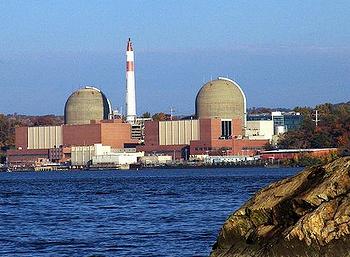 |
| Relicensing of reactors 2 and 3 at Indian Point nuclear power plant are among those put on hold by the NRC. (Photo courtesy Entergy) Environment News Service (http://s.tt/1krx0) |
The court noted that, after decades of failure to site a permanent geologic repository, including 20 years of working on the now-abandoned Yucca Mountain repository in Nevada, the NRC “has no long-term plan other than hoping for a geologic repository.”
Environment News Service (http://s.tt/1krx0)Therefore, it is possible that spent fuel will be stored at reactor sites “on a permanent basis,” the court said.
In its order today, the five-member NRC said, “Waste confidence undergirds certain agency licensing decisions, in particular new reactor licensing and reactor license renewal.”
“Because of the recent court ruling striking down our current waste confidence provisions, we are now considering all available options for resolving the waste confidence issue, which could include generic or site-specific NRC actions, or some combination of both,” the agency said. “We have not yet determined a course of action.”
“In recognition of our duties under the law, we will not issue licenses dependent upon the Waste Confidence Decision or the Temporary Storage Rule until the court’s remand is appropriately addressed,” the NRC said.
The NRC’s order extends only to final license issuance. “All licensing reviews and proceedings should continue to move forward,” the agency said.
 |
| https://fbcdn-sphotos-g-a.akamaihd.net/ hphotos-ak-ash3/c0.0.400.400/p403x40 3/539254_472855986065974_886434092_n.jpg |
New York Attorney General Eric Schneiderman brought legal action against the NRC because of his concerns about Entergy’s relicensing application for two reactors at Indian Point power plant on the Hudson River at Buchanan, New York, just 24 miles north of New York City. Entergy’s license to operate Indian Point expires on September 28, 2013.
Schneiderman said today, “The storage of nuclear waste at nuclear power facilities poses long-term health and environmental risks, including the risk of leaks from spent fuel pools and fires. Despite this, the NRC has refused my repeated requests to address the serious risks of long-term, on-site storage of nuclear waste in Indian Point’s relicensing proceeding.”
“In light of my recent federal appeals court victory and a related contention I filed last month in the relicensing proceeding, however, it appears that the NRC has finally changed course. Today, in a victory for the 17 million people living and working close to Indian Point, the NRC has committed to addressing the risks posed by long-term nuclear waste storage at the facility before making any relicensing decisions,” Schneiderman said.
The NRC also received “a series of petitions” on this matter, including one filed June 18 by 24 groups from across the United States urging the agency to respond to the court ruling by halting final licensing decisions until it has completed a rulemaking on the environmental impacts of spent nuclear fuel.
In hailing the NRC action in a statement today, the groups said that most of the 19 reactor projects are already “essentially sidetracked by the huge problems facing the nuclear industry, including an inability to control runaway costs, and the availability of far less expensive energy alternatives.”
Former NRC Commissioner Peter Bradford said, “It is important to recognize that the reactors awaiting construction licenses weren’t going to be built anytime soon even without the court decision or today’s NRC action. Falling demand, cheaper alternatives and runaway nuclear costs had doomed their near term prospects well before the recent court decision.”
“Important though the court decision is in modifying the NRC’s historic push-the-power-plants-but-postpone-the-problems approach to generic safety and environmental issues, it cannot be blamed for ongoing descent into fiasco of the bubble once known as ‘the nuclear renaissance,’” said Bradford, who now teaches law at Vermont Law School and serves as vice-chair of the Union of Concerned Scientists.
Diane Curran, an attorney representing some of the groups in the Court of Appeals case, said, “When the federal appeals court ordered NRC to stop and consider the impacts of generating spent nuclear fuel for which it has found no safe means of disposal, the agency could choose to appeal the decision by August 22nd or choose to do the serious work of analyzing the environmental impacts over the next few years. With today’s commission decision, we are hopeful that the agency will undertake the serious work.”
Lou Zeller, executive director of Blue Ridge Environmental Defense League, a petitioner to the court, said, “It appears that the commissioners have, at least initially, grasped the magnitude of the court’s ruling and we are optimistic that it will set up a fundamentally transparent, fair process under the National Environmental Policy Act to examine the serious environmental impacts of spent nuclear fuel storage and disposal prior to licensing or relicensing nuclear reactors.”
The petitioners had asked for assurance that they will be able to participate in future NRC waste confidence proceedings. “We hereby provide that assurance,” the agency said in its order. “The public will be afforded an opportunity to comment in advance on any generic waste confidence document that the NRC issues on remand.”
The NRC acknowledged that it will be in court again over its site-specific waste confidence actions and that it is “now in receipt of a number of new contentions and associated filings concerning waste confidence.”
Original http://ens-newswire.com/2012/08/07/u-s-freezes-all-nuclear-power-plant-licensing-decisions/
 |
| https://fbcdn-sphotos-b-a.akamaihd.net/ hphotos-ak-ash4/190019_101510888826 71941_838845067_n.jpg |
Subscribe to:
Posts (Atom)