Translate

Showing posts with label Nuclear Waste. Show all posts

Los Alamos studying alternatives for toxic waste

Created: 03/11/2014 4:55 PM 


By: The Associated Press
ALBUQUERQUE, N.M. (AP) - With the nation's only underground nuclear waste dump shuttered by a mysterious leak, Los Alamos National Laboratory has begun looking at alternatives for getting toxic waste off its campus.
Lab spokesman Matthew Nerzig confirmed Tuesday that officials have begun looking at options if the Waste Isolation Pilot Project in Carlsbad remains closed indefinitely.
The presence of that waste, stored outside with little protection, came to the public's attention three years ago as a massive wildfire lapped at the edges of the sprawling lab property.
The lab has since agreed to have it all removed from the mesa by the end of June.  The lab was ahead of schedule for getting the nearly 4,000 barrels to WIPP when back-to-back accidents, including a radiation release, closed the repository last month.http://www.kob.com/article/stories/S3358132.shtml?cat=500#.Ux-mBIFArqA

http://www.abqjournal.com/366480/abqnewsseeker/los-alamos-studying-alternatives-for-toxic-waste.html

Los Alamos, New Mexico
CDP
View from Camp May Trail
Location of Los Alamos, New Mexico
Coordinates:35°53′28″N 106°17′52″WCoordinates:
CountryUnited States
StateNew Mexico
CountyLos Alamos


2,500 nuclear waste shipments through town each year


Posted on31 May 2013.  

(Editor’s note: An earlier version of this story incorrectly reported that 25,000 nuclear waste shipments go through Pahrump each year. That figure was for a 10-year period.)

By Selwyn Harris

Pahrump Town Manager Bill Kohbarger said he had two different impressions before and after a special presentation on the transportation of radioactive nuclear waste through the heart of Pahrump.
On Tuesday evening, Nye County Nuclear Waste Repository Office consultant Dr. Michael Voegele provided an in-depth look at the logistics involved in transporting waste to the Nevada National Security Site NNSS .
Much to Kohbarger’s surprise, he said the presentation gave him a renewed reason to believe that such transports are relatively safe.
http://pvtimes.com/news/25000-nuclear-waste-shipments-through-town-each-year/

 Selwyn Harris / Pahrump Valley Times - This unidentified truck was recently spotted driving through town. Signs indicate it is carrying radioactive material. Similar shipments, about 10 each, travel through Pahrump on their way to the test site for storage.

Three Mile Island Accident & NRC Lies


Laura Tattoo

"KEEP IN MIND, THE TMI (THREE MILE ISLAND) NUCLEAR POWER PLA
NT AUTOMATICALLY SHUT DOWN TWICE IN JUST THE LAST MONTH!!! THE FIRST TIME A HEATING ELEMENT WAS REPLACED AND THIS TIME A PUMP HAD TO BE REPLACED

"Three Myths of the Three Mile Island Accident (lecture in 2009)

Nuclear engineer Arnie Gundersen gives a talk on his calculations of the amount of radiation released during the accident at Three Mile Island. Mr. Gundersen's calculations differ from those of the NRC's and official industry estimates. Arnie Gundersen was a senior executive in the nuclear industry with over twenty years experience. Mr. Gundersen holds Bachelors and Masters degrees in Engineering from Rensselaer Polytechnic Institute. In 1990 he came forward as a whistleblower and was fired that same year. Over the next several years, his case got a great deal of attention, and he testified before Congress during hearings on ways to protect whistleblowers. Mr. Gundersen is now a prominent nuclear safety expert witness."

http://www.fairewinds.com/content/three-myths-three-mile-island-accident

Three Myths of the Three Mile Island Accident | Fairewinds Energy Educatio

www.fairewinds.com

Nuclear engineer Arnie Gundersen gives a talk on his calculations of the amount
of radiation released during the accident at Three Mile Island. Mr. Gundersen's calculations differ from those of the NRC's and official industry estimates. Arnie Gundersen was a senior executive in the nuclear industry...
-----------------------------------------

Avertable Earth Changes, Nuclear Power and Mutual Survival

Public event · By Laura Tattoo

https://www.facebook.com/events/488870871125605/495004483845577/?notif_t=plan_mall_activity


Three Mile Island Accident

US bank finances UAE project

 10 September 2012

The Export-Import Bank of the United States (Ex-Im Bank) is to lend the Barakah One Company $2 billion to underwrite the export of US components and services for the construction of the the United Arab Emirates' (UAE's) first nuclear power plant.

The Barakah nuclear power plant will comprise four Korean-designed APR-1400 pressurised water reactors, but the bank says the $2 billion credit line will support some 5000 jobs in the USA. US company Westinghouse is a member of the Korea Electric Power Company (Kepco)-led consortium which was selected to build the plant, and will provide a range of components and services including reactor coolant pumps, controls, engineering services and training.

The Ex-Im Bank is a federal agency which helps to support US manufacturing jobs by filling gaps in private export financing. Before approving the loan, the bank conducted a "detailed and extensive" risk assessment of the Barakah project.

The loan is the bank's largest ever transaction in the UAE as well as its first financing of a 'greenfield' nuclear plant in over a decade. It has the support of the US National Security Council and the US departments of state and energy. Noting the importance of the transaction to the US economy, Ex-Im Bank chairman and president Fred Hochberg said the bank would also "make history" by backing the construction of the first nuclear power plant in the region.

Construction officially began at Barakah in July, and the first unit is scheduled to enter service in 2017.

Researched and written
by World Nuclear News


 Original:  US bank finances UAE project

Beyond Nuclear Fact Sheet Catastrophic Risks of GE BWR Mark I

High-Level Radioactive Waste Storage Pools

High-Level Radioactive Waste Storage Pool Fire at Fukushima Daiichi


The Fukushima Nuclear Catastrophe has clearly shown just how risky General Electric Boiling Water Reactors of the Mark I design are, including their high-level radioactive waste (HLRW) storage pools. Although the U.S. nuclear power establishment is still trying to deny it, evidence has mounted that Fukushima Daiichi Unit 4’s pool boiled dry to the point that highly radioactive irradiated nuclear fuel assemblies were exposed to air overheated, caught fire, and discharged catastrophic amounts of radioactive cesium-137 directly into the environment. This is because GE BWR Mark I pools – as with most pools at nuclear plants – are not locate within a primary radiological containment structure. Also, at Fukushima the reactor meltdowns and explosions damaged or destroyed the secondary containment structures (referred to as reactor buildings), at Units 1, 3 and 4, leaving those pools open to the sky. Unit 1 has since been covered with a tent. Unit 2 did suffer relatively small hole in its reactor building, as well.

As Stohl et al. have reported: “Our results indicate that 137Cs emissions peaked on 14–15 March but were
generally high from 12 until 19 March, when they suddenly dropped by orders of magnitude exactly when
spraying of water on the spent-fuel pool of unit 4 started. This indicates that emissions were not only coming
from the damaged reactor cores, but also from the spent-fuel pool of unit 4 and confirms that the spraying wa an effective countermeasure.”1 Thus, the HLRW fire in the Unit 4 storage pool caused some of the worst
radioactive Cs-137 releases during the catastrophic first week at Fukushima. It was his concern that the Unit 4 pool had boiled dry that prompted U.S. Nuclear Regulatory Commission (NRC) Chairman Gregory Jaczko, in the very first days of the catastrophe, to order an emergency warning to Americans in Japan to evacuate to at least 50 miles away from the Fukushima Daiichi nuclear power plant.

The Reactor No. 4 pool contained 135 tons of irradiated nuclear fuel; Reactor No. 1’s pool had 50 tons, No. 2’ 81 tons, and No. 3’s 88 tons. It took months for Tokyo Electric Power Company (TEPCO) and emergency responders to restore regular cooling water flow to certain of the pools. Some may still lack it. To restore water to the pools, as the thermally hot irradiated nuclear fuel boiled it away, ad hoc cooling efforts have include attempts to drop water by helicopter, as well as water spraying by fire truck, concrete pump truck, and even rio control water cannons. The Unit 4 reactor building is severely listing; its pool floor is supported by steel jacks for fear that it could fall out. A large aftershock could collapse the pool, instantly drain its cooling water, an reignite a radioactive waste fire. Unit 3’s pool appears filled with debris, so the condition of its irradiated fuel i unclear. Given the dangers on-site, including high radiation dose rates, when and how TEPCO and/or th Japanese federal government will be able to remove the HLRW to a safer location is yet to be determined Also, it is unclear when, or even if, a close examination of the four pools will occur, to determine what exactly happened where, why, and how bad the radioactivity releases have been.
What are the risks?

While all nuclear power plant HLRW storage pools are risky, GE BWR Mark I pools are especially vulnerable to accidents or attacks. A boil down or drain down of the cooling water could spark a fire in the irradiated fuel, as seen at Fukushima. GE BWR Mark I pools are elevated four to six stories high, above the reactor as well as outside the primary containment structure. The reactor building is not robust, as shown by the explosions at Fukushima. The design made it easier for the plants to remove irradiated fuel from the reactor core directly into the pool, but puts the pools at increased risk of heavy load drops, attacks by airplanes, etc. Emergency response is complicated by the pools’ high elevation above ground. NRC has not required pools to have emergency backup power connected to cooling systems, nor emergency make up water. Thus, they...(Keep reading http://www.beyondnuclear.org/storage/catastrophic%20risks%20of%20GE%20BWR%20Mark%20I%20HLRW%20storage%20pools.pdf )

超越核實況報導 奇異馬克一型沸水堆的災難性風險


超越核實況報導
奇異馬克一型沸水堆的災難性風險
高水準放射性廢物存儲池
高水準放射性廢物存儲池火福島第一核電站
福島核災難已清楚顯示多麼冒險一般電動沸騰水反應堆
馬克一型包括其高級別的放射性廢物 (廢料) 存儲池。雖然美國核電建設仍試圖否認它、 證據已裝入該 〃 4 號的池煮幹到高放射性輻照的核燃料元件被暴露在空氣中,點過熱、 著火了,和出院災難性數量的放射性銫-137 直接進入環境, 這是因為 奇異馬克一型沸水堆池 — — 因為在核工廠 — — 大多數池不是位於在主放射安全殼結構。此外,福島反應器的崩潰和爆炸損壞或毀壞的二級結構 (稱為反應堆廠房)、 單位 1,3,並向天空打開 4,離開這些池。
單元 1 一直以來被一頂帳篷。確實受到單位 2其反應堆廠房,以及孔相對較小。
作為施托爾 et 報告說:"我們的研究結果表明 137 排放 3 月在 14–15 上達到頂峰,但被
從 3 月 19 日,當他們突然下跌數量級到底何時才 12 一般較高4 號機組開始乏燃料池上水的噴塗。這表明排放不了才來從破損反應堆芯,而且還從 4 號機組的乏燃料池,並確認噴塗是有效對策。
"1 這樣,單位 4 存儲池的廢料大火造成一些最差放射性銫-137 釋放期間災難性的第一個星期在福島。這是他的關切,單位 4池已經煮幹,在促使美國核監管委員會 (NRC) 主席葛列格里姚茨科這場災難,命令在日本的美國人在疏散到緊急警告的最初幾天從福島第一核電站的至少 50 英里。
反應堆號 4 池所載 135 噸的輻照核燃料 ;1 的反應堆號儲存了 50 噸, 2 號的 81 噸和 3 號 88 噸。東京電力電源公司 (東京電力公司)花了幾個月的 和緊急急救員要恢復定期冷卻水流向某些池。一些仍可能缺少它。若要還原水到池,如熱熱的輻照的核燃料煮沸它,特設冷卻努力包括試圖用直升機,放水,以及水噴霧消防卡車、 混凝土泵車、 甚至暴動控制水炮。單元 4 反應堆廠房嚴重上市 ;由鋼的插孔,支援其池底因擔心它可能會掉出來。強烈餘震可以折疊池,立即耗盡其冷卻水,及重燃放射性廢物火。
單元 3 池出現充滿了碎片,所以其輻照燃料的條件還不清楚。鑒於危險現場,包括高輻射劑量率、 東京電力公司和/或日本的聯邦政府何時和如何將能夠刪除到一個安全的位置廢料尚待確定。
此外,目前尚不清楚時,或即使,四個池的接近考試將會出現,以準確確定什麼
凡發生了,為何,以及如何壞放射性釋放了。
有哪些風險?
雖然所有核電站廢料存儲池都都有風險,奇異馬克一型沸水堆都是特別易受傷害意外或攻擊。A 歸結或下來的冷卻水流失可能引發輻照燃料火災,福島發生了。奇異馬克一型沸水堆池是四至六層樓高高架的高架,上面的反應堆以及作為主安全殼結構之外。反應堆廠房不是強健,如圖所示的福島爆炸。設計使廠房從反應堆堆芯直接進入刪除輻照的燃料更容易儲存,但放在重負荷下降,燃料池風險增加飛機等的攻擊。緊急情況回應由池的高海拔地面變得複雜。NRC 已不需要的池來了緊急備用電源連接到冷卻系統,也沒有緊急補水量。因此,他們仍然易受斷電,像福島由於地震和海嘯發生的情況。
在美國,主電網已失敗龍捲風、 颶風、 水災、 火災、 冰風暴、 人為錯誤,wildlife2,
等,並已與美國緊急備用的柴油發電機故障的令人不安的圖案核 plants.3
多次的警告置若罔聞下降
幾十年來NRC 早知道池的風險,在 2001 年年初報告廢料火災可能導致約 25,000 潛在的癌症死亡人數在 2003 年 9/11 之後在 500 英里下風處.4 攻擊,阿爾瓦雷斯 et 發表一份報告,說明如何在美國輻照的核燃料池火能呈現區域無法居住,將比創建的車諾比爾意外事故高達 60 倍.5 
美國國家科學院在 2005.6 給予確認 et · 阿爾瓦雷斯的調查結果奇異馬克一型沸水堆是,核安全聯盟,組成的數十個環境加劇的風險組,敦促的決策者優先進入硬化現場存儲清空從這些池廢料(胡),它防止意外,並鞏固它的攻擊 ;近 200 個組織現在贊同另一份重要報,阿爾瓦雷斯 HOSS.7 重複他對風險的沸水堆池存儲中的警告美國在福島核.8 超越之後提交 NRC 與應急執法呈請書月後,福島災難開始,要求在奇異馬克一型沸水堆上安裝緊急備用電源。 
雖然加國研會在 2011 年 12 月已審查這一問題,其福島專責小組同意一年後福島、 國研尚未需要提昇安全.9 
在美國的 24 個 奇異馬克一型沸水堆廢料存儲池在哪裡?
在美國"雙胞胎"設計對福島第一核電站單位 1 到 4 之間的有 23 運行的反應堆。他們
是: 
布朗一渡輪 1、 2 和 3 (AL) ; 
布勞恩斯魏克 1 & 2 (NC) ; 
庫珀 1 (NE) ; 
德累斯頓 2 和 3 (IL) ; 
杜安 · 阿諾德 1
(IA) ;費米 2 (MI) ; 
菲茨派翠克 1 (紐約) ;
 孵化 1 & 2 (GA) ; 
希望克裡克 1 (NJ) ; 
蒙蒂塞洛 1 (錳) ; 
九英里點1 (紐約) ; 
克裡克蠔油 1 (NJ) ; 
桃底部 2 和 3 (PA) ; 
朝聖者 1 (MA) ; 
四城市 1 & 2 (IL) ; 
佛蒙特州揚基隊 1 (VT)。 
此外,自 1995 年以來在 CT、 磨石單位 1 雖然反應堆已被永久關閉,它的主人,統領核的里士滿弗吉尼亞州"的結論他們將會保持磨石單位1 直到 2048年燃料中花了燃料池,在一個 SAFSTOR 的地位,而不是將燃料移至 ISFSI[獨立花燃料存儲安裝]。
阿爾瓦雷斯的 2011年報告中所述"10美國池包含比福島第一核電站更龐大更多廢料,美國的奇異馬克一型沸水堆標記當中最打包帶, 在美國的任何核電廠池作為廢料約 75%的商業 65,000 噸輻照的核燃料在美國,存儲池,,而 25%已轉移到幹罐子。核實用程式傾向于儘量使其,以推遲乾燥的儲存桶到成本的池未來。這大大增加了池的風險。恐慌性,在美國大多數奇異馬克一型沸水堆儲蓄很多, 比福島第一核電站所有四個反應堆單位放加起起來 (354 噸).11 更多廢料,
例如蠔克裡克 (NJ),最古老仍然經營原子反應堆 (1969年到 2012 年),美國已生成約 750 度量噸的廢料含 1 億 2500 萬居理的放射性物質 ;即使其輻照過燃料了一些轉移乾燥的儲存桶中,絕大多數仍留在池中。
佛蒙特州揚基已產生約 650 公噸的廢料,包含 1 億居理的放射性物質 ;它遭受附近小姐重
近年來載入下降。費米 2 (MI) 產生了將近 600 噸的廢料,含 9000 萬居裡 ;因為核廠的結構不足夠強烈焊接所有其輻照燃料都存儲在其池中,支援的起重機和完全載入的木桶重量的轉移操作 ;底特律愛迪生擁有承認這站停電,4 小時 12 分鐘內將導致池沸騰。 
同樣地,朝聖者 (MA)存儲所有的廢料,含有超過 7000 萬居理 ,在其池其超過 550 噸。
2012 年 1 月此聲明的註腳的版本張貼于:
HTTP://www.beyondnuclear.org/radioactive-waste-whatsnew/2012/2/6/catastrophic-risks-of-ge-bwr-mark-i-highlevel-
放射性 w.html
超越核
6930 卡羅爾大道,套房 400,派克、 MD 20912 T.301 時 270 時 2209 F.301 時 270 時 4000
電子郵件: info@beyondnuclear.org 網站: www.beyondnuclear.org
References
1 Stohl et al., “Xenon-133 and caesium-137 releases into the atmosphere from the Fukushima Dai-ichi nuclear
power plant: determination of the source term, atmospheric dispersion, and deposition,” Atmos. Chem. Phys.
Discuss., 11, 28319-28394, 2011, http://www.atmos-chem-phys-discuss.net/11/28319/2011/acpd-11-28319-
2011.html.
2 In the 1980s, a raccoon was electrocuted at the Fermi 2 nuclear power plant in Monroe, Michigan, and power
was lost to the plant from the electric grid. Fermi 2, by the way, is the largest GE BWR Mark I in the world, at
1,122 megawatts-electric.
3 http://markey.house.gov/press-release/august-24-2011-nrc-va-earthquake-highlights-need-update-usnuclear-
safety-standards
4 “Technical Study of Spent Fuel Pool Accident Risk at Decommissioning Nuclear Power Plants,” (NUREG-
1738), Feb. 2001, http://www.nrc.gov/reading-rm/doc-collections/nuregs/staff/sr1738/.
5 Robert Alvarez, Jan Beyea, Klaus Janberg, Jungmin Kang, Ed Lyman, Allison Macfarlane, Gordon
Thompson, and Frank N. von Hippel published “Reducing the hazards from stored spent power-reactor fuel in
the United States” in Science & Global Security, Vol. 11, No. 1, 2003.
6 The National Academy of Sciences Report on “Safety and Security of Commercial Spent Nuclear Fuel,” April
6, 2005.
7 See the Statement of Principles for Safeguarding Nuclear Waste at Reactors, including the list of signatories,
at http://www.ieer.org/reports/DOE_WasteContracts2010/HOSS_PRINCIPLES_3-23-10x.pdf.
8 Robert Alvarez, Introduction, “Spent Nuclear Fuel Pools in the U.S.: Reducing the Deadly Risks of Storage,”
Institute for Policy Studies, Washington, D.C., May, 2011, http://www.ipsdc.
org/reports/spent_nuclear_fuel_pools_in_the_us_reducing_the_deadly_risks_of_storage.
9 http://www.beyondnuclear.org/nuclear-reactors-whatsnew/2012/1/3/nrc-accepts-beyond-nuclear-petitionedactions-
for-review-at.html.
10 http://www.nrc.gov/info-finder/decommissioning/power-reactor/millstone-unit-1.html
11 U.S. Department of Energy, Final Environmental Impact Statement for Yucca Mountain, Table A-7, Feb.
2002.

$1.28B for Port Hope radioactive cleanup, NUCLEAR GENOCIDE IN CANADA


The Canadian Press

Posted: Jan 14, 2012 11:31 AM ET 

Ottawa says it will spend $1.28 billion over 10 years to clean up low-level radioactive waste in the Port Hope area east of Toronto.
The waste came from radium and uranium refining operations of the former Crown corporation Eldorado Nuclear and its private sector predecessors from 1933 to 1988.
The federal government says about 1.7 million cubic metres of the waste is located at sites in Port Hope and Clarington, about 100 kilometres east of Toronto.
The initiative will be carried out as two projects — one for Port Hope and the other for the Clarington site known as Port Granby. (Keep reading...http://www.cbc.ca/news/canada/toronto/story/2012/01/14/toronto-port-hope.html )

===========================
 

Port Hope's nuclear past pits economic interests against health


In mid-November, when the weather was still gorgeous and tourists were still meandering through its picturesque downtown streets, Helen Caldicott sentenced Port Hope to death.

“It's a disaster,” the renowned doctor and anti-nuclear activist told a gathering of Port Hopers and a crush of reporters crammed into a hotel in Oshawa.

The mess can't be cleaned up, Caldicott said flatly of the low-level radioactive waste sprinkled around Port Hope.

“The entire town should be relocated and the Cameco refinery should be shut down.”
As she finished speaking, some 200 people who had listened attentively for an hour applauded loudly.
Back in Port Hope, residents sighed with frustration, gearing up for yet another fight to save the reputation of their town.

“Caldicott didn't even come here ... she said all those things from Oshawa and left,” says Liz Stewart, 61, a longtime resident. “We are tired of people doing this to Port Hope without knowing the facts. The town is safe and can absolutely be cleaned up.”

And just like that, Port Hope was back in the spotlight.

The town's nuclear past is its legacy and its curse. Eldorado Nuclear Ltd., which refined radium used for treating cancer, and uranium that helped the Manhattan Project develop the first atomic bombs, provided employment to hundreds in the town. But it also left Port Hope riddled with low-level radioactivity — and rancour.

The two have permeated every aspect of life in this town, pitting economic and social interests against health concerns. Friends have become foes. Tourism has taken a beating. Real estate deals have fallen through. Threats have become commonplace.

Uncertainty has become the great dividing line between those on opposing sides of Port Hope's ongoing debate. There is, simply, no middle ground.

The largest cleanup of radioactive waste in Canadian history will begin here later this year, as trucks and mechanical diggers move in to remove contaminated soil from numerous sites around town.
The project may eradicate the dark stain on the town, but it won't tackle the most important questions, some residents say.

“There is low-level radioactive waste everywhere in town . . . but the government has continuously refused to do an extensive health study,” says Andy Johncox, who worked at Eldorado for 14 years, until 1982.
The Canadian Nuclear Safety Commission says there is no danger to health in Port Hope; that more than 40 studies indicate residents have low levels of exposure to all types of contaminants.

There is, in fact, no undisputed evidence that radioactive materials released into the environment have harmed a single person in Port Hope.

But if the town is so safe, Johncox wonders: Why are millions of dollars being spent to clean it?
“I am all for the cleanup, but there are too many lingering questions,” says Johncox. “I'd really like to know the truth about Port Hope.” (Keep reading....http://www.thestar.com/news/gta/article/968112--port-hope-s-nuclear-past-pits-economic-interests-against-health

--------------------------------------------------------------------------------- 

‘Inside sources’ being investigated

By Joyce Cassin, Northumberland Today
PORT HOPE - A seemingly innocent e-mail sent to local media outlets is a cause for investigation by Atomic Energy of Canada Limited (AECL).

Last week, someone named ‘Michael Strong’ sent an e-mail stating: Families in the vicinity of St. Mary's School (10 Pine St. South) in Port Hope should be worried. Their children have been playing on a load of buried toxic radioactive waste in the playground for years. It’s publicly known that the school building was cleaned up, but “inside sources at the Port Hope Area Initiative” say there are almost 20,000 cubic meters of waste in the school yard also that isn't being talked about.

A call to Judy Herod, acting manager of stakeholder relations and communications, said that it’s well-known that high levels of radon gas were detected back in 1976/77 but that it was “cleaned up.” (Keep reading......http://www.northumberlandtoday.com/2012/09/03/inside-sources-being-investigated)

----------------------------------------------------------

NUCLEAR GENOCIDE IN CANADA

Part 1

In the Beginning - Port Radium Mine

 
The Port Radium mine opened in 1932 in the North West Territories. Radium is a radioactive material that is part of the decay chain of uranium. In the 1930s, radium was trumpeted as the new wonder drug to cure cancer and as a 'glow-in-the-dark' paint. It was the most expensive material on Earth at the time, commanding prices up to $125,000 per gram.
Canada's Department of Mines warned the Canadian Government in its 1932 'Blood Studies on Port Radium Miners' about the dangers of radiation and radon gas in particular. The report stated "that a hazard may exist in the breathing of air containing even small amounts of radon." No warning was given to the white miners or to the First Nations people from Deline who were hired as porters. The mine shut down and the radium industry collapsed in 1940 when its lethal health effects became known to the public.


One of the main uses for radium at the time was as a paint for the numbers on clock faces so they could be seen in the dark. The painting was done by hand, almost exclusively by women. To get a fine point on the brushes, the women would twirl the brush in their lips, thereby ingesting some of the radium. The health of the women deteriorated quickly; their jaws literally disintegrating.


The Canadian Government expropriated the mine in 1942 and created a company called 'Eldorado Nuclear Ltd' to supply uranium to the American nuclear weapons program. A Federal research team from Montreal sent to monitor the mine in 1945 reported "the radon content seems to be so high as to be definitely dangerous to the health of those working in the mine." Once again, no warning was given to the miners or to the First Nations people who transported the uranium ore.


Refer to: Somba Ke, a one-hour documentary on Port Radium and Deline by MacDonald Stainsby

Village of Widows
The First Nations people of Deline, North West Territories were hired to carry burlap sacks of uranium ore from the mine to the barges on Great Bear Lake. The bags of radioactive ore had to be handled several times on their journey. The workers slept on the bags of uranium all the way to Fort McMurray where they were transferred for shipment to the Port Hope Refinery.


In 1960, cancer claimed its first victim in Deline. They didn't know what it was because there had never been cancer there before. Over the next few years, most of an entire generation of men in the community died as a result of their exposure to the radioactive material. So many men died that Deline has become known as 'The Village of Widows.'


Cindy Kenny-Gilday from Deline wrote:
"Deline is practically a village of widows, most of the men who worked as labourers have died of some form of cancer. The widows, who are traditional women were left to raise their families with no breadwinners, supporters. They were left to depend on welfare and other young men for their traditional food source. This village of young men are the first generation of men in the history of Dene on this lake to grow up without guidance from their grandfathers, fathers and uncles. This cultural, economic, spiritual, emotional deprivation impact on the community is a threat to the survival of the one and only tribe on Great Bear Lake. It's the most vicious example of cultural genocide I have ever seen and its in my own home." 


The people of Deline did not know what was causing it. They contacted the Canadian Government for help. The Canadian Government did nothing despite illness rates twice as high as any other First Nations community in Canada. The Canadian Government waited until 1998 to inform Deline that it was their exposure to radiation that was killing them. They did not make this admission until after the people of Deline had identified the cause through their own research. Andy Orkin, an Ontario lawyer who worked on behalf of the Deline First Nations people said it best:
"We left them to die and hoped they would never ask any questions."

 .......

Summary
The Canadian government was repeatedly warned about the dangers from exposure to radiation from 1931 until 1976 by their own ministries and the American Government. Yet there is not a recorded instance in the 50 year period covered by this paper where the workers were warned of the danger. This is completely unacceptable behaviour from the Canadian government.
The other point to note is that First Nations people paid a much steeper price as a result of their exposure to the nuclear industry than the whites did. Deline, Serpent River and Blind River First Nations have paid a very high price to keep the lights on in Ontario.

End of Part 1
(Keep reading ......http://www.porthopehistory.com/nucleargenocide/nucleargenocide1.htm )


Nuclear Waste - Time to open up about pros and cons of DGR


By Phil McNichol
Dr. Gordon Edwards spoke at Dumpstock about the recent deep geological repository  discussion. He was to provide a different perspective than that of NMWO.
Dr. Gordon Edwards spoke at Dumpstock about the recent deep geological repository discussion. He was to provide a different perspective than that of NMWO.
There’s a good chance a community in Bruce County on or near the Lake Huron shoreline will be picked as the host site for the long-term underground storage of Canada’s growing stockpile of highly radioactive and dangerous “used” nuclear fuel.

Most (80%) of the 2.3 million bundles of used fuel currently in storage under water or in specially built dry containers are at three nuclear plants in Ontario, on the shores of Lake Huron (Bruce Nuclear) and Lake Ontario (Pickering and Darlington). By the time the proposed Deep Geological Repository (DGR) is ready that number could be as high as 7.2 million bundles. The Nuclear Waste Management Organization (NWMO) has estimated a DGR big enough to store that amount of used nuclear fuel would cost $24.5 billion in today’s money.

Yet, the Southampton Curling Club, with enough chairs set up for 600 or 700 people, was only half full for last Saturday’s “No Nuke Dump” town hall event, organized by the Save Our Saugeen Shores (SOS) citizens’ group.

A few local reporters were there, but none from the big city or national media. Just one member of Saugeen Shores’ municipal council, Taun Frosst, was there. The absence of area provincial and federal politicians was noted. Most obvious was the empty chair reserved for the “NWMO.” The organization had been invited to participate in a panel discussion, but didn’t send anyone.

Five of the 19 communities in Canada that have formally notified the NWMO of their interest in being chosen as the “willing” host site for its proposed Deep Geological Repository (DGR) are in southern Bruce County, near the Bruce nuclear plant.

The keynote presenter at the SOS event was Dr. Gordon Edwards, a recognized Canadian and international expert on nuclear safety for many years.

His power-point presentation was indeed powerful and certainly informative, even for an old hand who’s been following this issue, and nuclear safety in general for years. The questions and concerns he raised should have been heard by anyone with an interest in the DGR proposal, and nuclear energy in general, for that matter.

And that means not just everybody in this part of southern Ontario, but everybody in Canada, and even the world, Cheryl Grace told me right after the SOS event ended. “It’s a world issue,” said the SOS founding member and spokesperson, while trying to put the best face on a disappointing turn-out and especially the lack of media coverage.

Edwards started with the global perspective. He called last year’s earthquake/tsunami/nuclear disaster in Japan a “wake-up call” for the nuclear industry. “We have to change our attitude toward nuclear power,” he said. “Anything can happen. We have to really be prepared for the unexpected.”

But even more to the point, especially for this area, “turns out it was the nuclear waste inside the (four Fukushima) reactors that exploded,” he said. “The damage was due solely to the nuclear waste inside.”
First the main power was knocked out, and then the tsunami drowned out the back-up electrical generators. As a result, the pumps that are supposed to keep water circulating around the stored used nuclear fuel to keep it cool stopped working. The fuel overheated catastrophically. Containment walls melted, hydrogen gas levels rose and the reactor buildings exploded, releasing dangerous levels of radioactive products like Strontium 90 and Cesium into the environment.

Once inside the human body each radioactive particle emits potentially deadly radiation as it continues its prolonged disintegration, Edwards explained. He illustrated the point with a microscopic photograph of such a particle shooting out straight lines of radiation into the surrounding tissue. “They’re just like projectiles that crash into cells and do damage.”

Edwards said it’s hugely misleading to call used nuclear fuel “spent” as it sometimes is; it’s even too benign to call it “used.” It’s “many times more radioactive” than new fuel bundles before they’re put into reactors and subjected to the atom-splitting process, or “fission,” that unleashes huge amounts of energy, and radioactivity.

“That’s what they’re talking about finding a home for,” he said.

Used nuclear fuel buried in deep-rock caverns will continue to produce dangerous levels of radiation and heat in the form of “thermal pulses” with the potential to crack the rock for thousands of years, he said.
“If the Egyptian pyramids had been nuclear waste repositories we’d all be dead,” Edwards said. “They’ve all been looted.”

The NWMO says its Adaptive Phased Management plan for the locating and developing the proposed DGR
“involves realistic, manageable phases — each marked by explicit decision points with continuing participation by interested Canadians.  It is flexible, allowing for go, no-go decisions at each stage to take answer session with the advantage of new knowledge or changing societal priorities.”

But Edwards said the science to justify the proposed DGR is still too incomplete to proceed. “There are too many unanswered questions.”

He said there’s no point in packaging and transporting such dangerous material and burying it underground, and possibly having to re-package and transport it again if problems develop. “All the packaging and repackaging adds to the problem.

“Let’s frankly admit we don’t know how to deal with this.”

Later in a question and answer session Edwards called the NWMO’s current plan implementation, still in the early stages of finding a willing host community for the DGR site, “a deeply flawed process.” He said it appears to be politically motivated to show Canada has solved the used nuclear fuel storage problem when it actually hasn’t. “That’s why we need an unbiased organization.”

Edwards noted the Seaborn Panel in the late 1990s recommended the Canadian government quickly set up an organization to study all the options for the long-term storage of used nuclear fuel. Its first recommendation was that such an organization should be “arm’s length,” free of any conflict of interest involving the utilities that own and operate Canada’s nuclear plants.

But the board of directors of the NWMO, set up in 2002 by the former Liberal government of Jean Chretien, is made up of representatives of the utilities, with OPG in the majority position. “That’s not what was intended,” Edwards said.
Sure enough, OPG appears to have had a major influence on the direction NWMO study and planning has taken.
Before the NWMO was created it was widely thought the Canadian Shield, with its hard and very old igneous rock, was the most likely location for the safe, deep-rock burial of Canada’s used nuclear fuel. But the NWMO’s plan, approved by the Conservative government, leaves the door open for any “suitable” rock formation, including sedimentary.

The NWMO began looking at the possibility of locating such a facility in sedimentary rock formations, like those underlying southwestern Ontario, after OPG brought a detailed report of a study on the subject to it for consideration. The study was done by geologist Martin Mazurek at the University of Bern for OPG. It specifically mentions the Bruce Megablock, the area of limestone bedrock underlying much of Grey-Bruce, as suitable for development of a DGR for nuclear waste.

OPG was already planning development of a DGR for what it calls low and intermediate-level nuclear waste in the vicinity of its Western Waste Management Facility at the Bruce nuclear site.

Shortly after the NWMO got the OPG/Mazurek report it shut down a facility in northern Manitoba where 15 years of research had gone into studying the suitability of the Canadian Shield for a DGR. By 2006 sedimentary rock formations were the NWMO’s focus.

Edwards said it’s “astounding” the NWMO is now thinking about putting the DGR beside Lake Huron.
OPG is currently seeking final approval from the Canadian Nuclear Safety Commission (CNSC) for its low/intermediate DGR which it hopes to begin work on next year.

The NWMO is working closely with OPG on that project, including the effort to get final regulatory approval.

Municipalities in the vicinity of Bruce nuclear, including Saugeen Shores, have signed an agreement with OPG to use their “best efforts” to support its DGR or risk losing millions of dollars worth of annual compensation payments.

The NWMO, with the OPG and its obsession with message-control in the driver’s seat, has so far shown no interest in a wide-open public discussion of the pros and cons of putting a deep-rock storage dump for highly radioactive used nuclear fuel beside one of the Great Lakes.

“There’s something fishy going on here,” Edwards said at one point during last Saturday’s SOS event.
I couldn’t agree more. I’ve been smelling it for a long time.

Phil McNichol appears Saturdays.  (Original Lucknow Sentinel  )

Chinese Translation:

Excellent statement by Gordon Edwards on Canada's nuclear waste problem, and "spent" fuel: "...it’s hugely misleading to call used nuclear fuel “spent” as it sometimes is; it’s even too benign to call it “used.” It’s “many times more radioactive”  than new fuel bundles before they’re put into reactors and subjected to the atom-splitting process, or “fission,” that unleashes huge amounts of energy, and radioactivity.
戈登 · 愛德華茲對加拿大的核廢物問題和稱為"廢"燃料:"... ...,是非常誤導稱呼使用後的核燃料為"消耗 "(spent),  ;甚至太良性的叫它"使用"。  它比之前他們放入反應爐的新燃料束產生" 更多更多倍的放射性",這是因為在原子分裂的過程中或"裂變"所施展的大量的能量和放射性。

“That’s what they’re talking about finding a home for,” he said.
" 那就是他們說找個家的東西" 他說。

Used nuclear fuel buried in deep-rock caverns will continue to produce dangerous levels of radiation and heat in the form of “thermal pulses” with the potential to crack the rock for thousands of years, he said.
使用後的核燃料被埋在深層岩石洞室將會繼續產生輻射和熱"熱脈衝", 會造成岩石崩裂, 危險ˊ之高將歷時數千年 ,他說。

“If the Egyptian pyramids had been nuclear waste repositories we’d all be dead,” Edwards said. “They’ve all been looted.”
"如果埃及的金字塔 是核廢物處置庫,我們早就死光了,"愛德華茲說。"他們已經全部被掠奪。"
 - 海倫凱帝克博士

主文
在安大略省的社區上或附近的休倫湖海岸線將被拾起的主機網站的長期地下儲存的加拿大越來越庫存的高放射性和危險的“使用”核燃料機會很大的。 大多數(80%)在安大略省的3個核電廠的230萬束在水中或在專門修建的乾燥容器中使用過的燃料,目前在存儲,(布魯斯核)休倫湖和安大略湖(Pickering和達林頓)的海岸上。

建議深地質處置庫(DGR)已經準備好時,這一數字可能高達720萬束。核廢物的管理組織(NWMO)已估計一個DGR大存儲,量使用過的核燃料將花費在現今的錢$ 245億元。 然而,在南安普敦冰壺俱樂部,有足夠的椅子為600或700人成立,是唯一的上週六的“無核武器轉儲”市政廳事件的保存我們的Saugeen的海岸(SOS)的公民團體,只有組織的一半。

有 一些地方的記者在那裡,但沒有從大的城市或國家的媒體來的記者。Saugeen海岸市議會裡的一員Taun Frosst在那裡。省和聯邦的政客完全沒有注意到。最明顯的空椅子為“NWMO保留。”該組織已被邀請參加了小組討論,但沒有派任何人來。

在加拿大的19個社區中選擇作為主要地點已有5個已正式通知NWMO他們的興趣,其建議的深地質處置庫(DGR)在布魯斯郡南部,布魯斯核電廠附近 。

的主旨演講在SOS事件是戈登博士愛德華茲認可的加拿大和國際核專家多年的安全。 他的力量的投影的確是強大的和肯定的信息,即使是老手,誰一直在關注這一問題,並在多年的核安全。任何人有興趣在DGR的建議,和一般的核能應該已經聽到他所提出的問題和關注,對於這個問題, 這意味著不只是每個人在安大略省南部的這部分,但每個人都在加拿大,甚至全世界。

SOS事件一結束後, 桂斯謝麗爾 告訴我說:“這是一個世界問題,”SOS創始成員和代言人,在令人失望的開端同時努力朝向最好  ,尤其是缺乏媒體的報導。

 愛德華茲開始用全球的角度來看。他稱去年在日本的的地震/海嘯/核災難為“敲響了核工業的警鐘”。“我們必須改變我們的核電態度,”他說。“任何事情都有可能發生。我們必須準備意想不到的。“ 但更重要的是,尤其是對於這方面,“原來,這是核廢料(4福島縣)反應堆發生爆炸,”他說。“損害完全是因為裡面的核廢料。” 首先,主電源被淘汰,然後在海嘯淹沒了後備發電機。其結果是,應該保持水圍繞所存儲的使用過的核燃料循環,以保持它冷卻泵停止工作。燃料過熱的災難性。容器壁熔化,氫氣水平上升,反應堆廠房爆炸,釋放出危險的放射性產品,如鍶90和銫到環境中, 一旦進入人體的放射性粒子放射出可能致命的輻射,因為它繼續其長期的解體,愛德華茲解釋。

他說明了這一點,這樣的粒子拍攝出直線的輻射到周圍組織的顯微鏡照片。“它們就像是核彈崩潰進入細胞,並造成傷害。” 愛德華茲說,稱呼使用後的核能燃料為“消耗”是嚴重的誤導性作為 有時 甚至良性稱它“使用。”這和之前新的燃料包相比是含有“許多倍的放射性“,他們投入反應堆的原子分裂過程中,或”裂變“,釋放大量的能量,以及放射性物質。 “這是他們在談論什麼找到一個家, “他說。 埋在深岩洞的使用過的核燃料將繼續產生危險水平的輻射和熱量的潛力,破解岩石千百年來的“熱脈衝”的形式,“如果埃及的金字塔 是核廢物處置庫,我們早就死光了,"愛德華茲說。

NWMO 對OPG 和主消息控制的狂熱, 到目前為止未顯示出對放置高放射性核廢料在深岩層儲藏庫將對大湖區產生的利弊做個公民討論。

 " 事有玄機", 愛德華茲在上周六SOS會議中說 "我已經懷疑有詐很久了"

Nuclear Power Plants in Taiwan


Taiwan will still have enough electricity even if it shuts down all 3 nuclear power plants.     # 4 nuclear power plant is under construction regardless Fukushima's lessons.


Government seeking to reduce nuclear reliance without sincerity 

2012/08/18 21:19:59


.......Abandoning nuclear power requires careful deliberation, said Hsu Sheng-hsiung, chairman of the Chinese National Federation of Industries, one of the meeting participants.

The high cost of a nuclear-free society will not only influence business operations but also individuals, he added........  (W T F???)

http://focustaiwan.tw/ShowNews/WebNews_Detail.aspx?Type=aIPL&ID=201208180025 

--------------------------------------------------------------------------------------------------


High Risk
Indeed, the risk of nuclear power plants hit by an earthquake in Taiwan is very high, as 朱淑娟 (Shu-Chuan Chu) points out:
核電廠距離經過金山海岸的「山腳斷層」只有5到7公里。核四廠址5公里內就有6條「非活動斷層」,且貢寮核四廠址的半徑80公里海域內,有70幾座海底火山,其中的11座更處於活火山的狀態。
The first and second nuclear power plants are five to seven kilometers [km] away from the Shanjiao Fault in the Kinshan coastal area. The fourth nuclear power plant is less than five km away from six inactive faults. In addition, within a radius of 80 km of the fourth nuclear power plant, there are more than 70 undersea volcanoes, 11 of them are active.
Kenting #3 Nuclear Power Plant, Taiwan


核一廠耐震設計是0.3g,核二、核三、核四為0.4g,遠不如日本核電廠原本的耐震設計0.6g(g為重力加速度)。日本核電廠為了因應強震,已開始進行耐震強度提昇工程到1.0g,但台灣卻仍無視於地震的威脅。
Beach near Kenting nuclear plant, Taiwan. Image by Flickr user impaulsive photography (CC BY 2.0).
[In Taiwan] The anti-earthquake design is 0.3g [g = measure of peak ground acceleration] for the first nuclear power plant and 0.4g for the second, third, and fourth plants. They are far weaker than the anti-earthquake design in Japan, which is [typically] 0.6g. Due to its strong earthquakes, Japan plans to have 1.0g anti-earthquake design for new nuclear power plants. Nevertheless, not many people in Taiwan care about the earthquake threat.
Because of the geographical similarities, 菊地洋一 (Yoichi Kikuchi), a Japanese expert in nuclear power plants, warns that nuclear power plants in Taiwan may have similar structure-related problems as those observed in Japan:
台灣核電廠全停掉電都夠用 圖片來源:黃明堂. 
台灣的核一、核二廠所用的反應爐與日本都是屬於同一型,而且兩國都是多地震國家,所以在日本發生的問題,台灣不可能會沒有 問題。最近的 BWR 型屬使用最高品質的 SUS316L 製造 (材料的質地較軟,因此較不容易產生裂痕的現象) ;各電力公司一再強調,這種材料絕對不會發生裂痕問題。可是實際上它還是發生了,這次日本東京電力公司隱瞞事件(註: 2002年)中也發現,其它的部分同樣也有裂痕。
The nuclear reactors in the first and second nuclear power plants in Taiwan are similar to many nuclear reactors in Japan. Since there are frequent earthquakes in Taiwan and Japan, what has happened in Japan will also happen in Taiwan. The recent design of the Boiling Water Reactor (BWR) has adopted high-quality SUS317L stainless steel as the construction material, which is softer and has fewer cracking problems, and all the nuclear power companies have kept stressing that this material will never develop cracks. In the current accident [Fukushima], we have seen the cracks. In fact, far back in 2002, cracks were found in the BWR in the investigation of the Tokyo electric power company scandal.
To summarize, the nuclear power plants in Taiwan are not immune to the natural forces that destroyed the Fukushima nuclear power plant.

http://globalvoicesonline.org/2011/03/16/taiwan-countrys-nuclear-power-plants-are-high-risk/ 

---------------------------------------------------------------------------------------------------------------------------------------


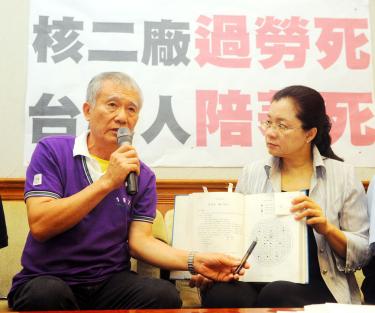
Retired Taiwan Power Co technician Lee Kuei-lin,
left, accompanied by Democratic Progressive Party
Legislator Tien Chiu-chin, yesterday explains the
seriousness of recent accidents at the Guosheng Nuclear
Power Plant at the legislature.Jun 19, 2012

Photo: Wang Min-wei, Taipei Times

 
Cracks of up to 30cm have been found on the core shroud of the No.1 reactor at the idled Guosheng Nuclear Power Plant in Wanli District (萬里), New Taipei City (新北市), an Atomic Energy Council official has confirmed.

Civic groups yesterday warned against reactivating the plant.

In addition to unsettled concerns about cracked anchor bolts at the reactor, Green Consumers Foundation chairman Jay Fang (方儉) revealed that two cracks were found on welded parts of the core shroud, which Fang said could lead to disaster if the reactor is reactivated without repairs.

Deputy Director of the Atomic Energy Council’s (AEC) Department of Nuclear Regulation Chen Yi-pin (陳宜彬) was quoted by the Chinese-language Liberty Times (the Taipei Times’ sister newspaper) yesterday as having confirmed on Sunday that the two long cracks were discovered during routine checkup and maintenance in March.

The core shroud is a large cylinder of circumferentially welded plates made of stainless steel, surrounding the reactor fuel core, which is composed of fuel rods assembled into bundles.


------------------------------------------------------------------------------------------------------

From Wikipedia, the free encyclopedia

 
Nuclear power plants in Taiwan (view)
Red pog.svg Active plants
Green pog.svg Under construction plants
Taiwan currently has 4884 MWe of nuclear power capacity by means of 3 active plants and 6 reactors, which makes up around 8.1% of its national energy consumption. The technology chosen for the reactors has been General Electric BWR technology for 2 plants and Westinghouse PWR technology for the Maanshan Nuclear Power Plant. The Lungmen Nuclear Power Plant is currently under construction, but has encountered public opposition and a host of delays.

Active seismic faults run across the island, and some environmentalists argue Taiwan is unsuited for nuclear plants. A 2011 Natural Resources Defense Council report that evaluated the seismic hazard to reactors worldwide, as determined by the Global Seismic Hazard Assessment Program data, placed all of Taiwan's reactors within the highest risk group of 12 reactors within very high seismic hazard areas, along with some of Japan's reactors.

The Lanyu nuclear waste storage facility was built on Orchid Island (Lanyu) in 1982. The plant receives nuclear waste from Taiwan's three nuclear power plants operated by state utility Taiwan Power Company (Taipower). About 100,000 barrels of nuclear waste from the nation’s three operational nuclear power plants have been stored at the Lanyu complex.[3] In 2002 and 2012, there were major protests from local residents, calling on Taipower to remove the nuclear waste from the island.

Organization

All plants are run by Taipower. The Atomic Energy Council (AEC) of the Republic of China is effectively the regulatory body, but plants are also subject to International Atomic Energy Agency safeguards. There are two additional plants under construction equipped with GE latest BWR technology in Lungmen. They will each deliver 1300 MWe of power at peak.

Nuclear waste controversy

空拍蘭嶼核廢料儲放廠,該廠當初是以罐頭工廠的名義向當地民眾說明的。
Nuclear Waste Deposit site in Orchid Island.
 
http://nrch.cca.gov.tw/ccahome/search/search_
meta.jsp?xml_id=0002736523&dofile=getImage.
jsp?d=1320330870959&id=0002741775&filenam
e=cca200103-hp-0983_c_b18188514-0001-i.jpg
The Lanyu nuclear waste storage facility was built on Orchid Island (Lanyu) in 1982. The storage plant is at the southern tip of the 45-square-kilometer island, which is located off the southeastern coast of Taiwan proper. The plant receives nuclear waste from Taiwan's three nuclear power plants operated by state utility Taiwan Power Company (Taipower). Islanders did not have a say in the decision to locate the facility on the island.


In 2002, almost 2,000 protesters, including many Aboriginal residents of Taiwan's Orchid Island staged a sit-in in front of the storage plant, calling on Taipower to remove nuclear waste from the island.

One of the most serious issues
=tbn:ANd9GcTS4HdaEE rXhjuxu3uhCEPwIVhBj
XPHFnEGkETwOiOYTnnH7ZMOHQ

They were also protesting against the government's failure to keep its pledge to withdraw 100,000 barrels of low-level nuclear waste from their isle by the end of 2002. In a bid to allay safety concerns, Taipower has pledged to repackage the waste since many of the iron barrels used for storage have become rusty from the island's salty and humid air. Taipower has for years been exploring ways to ship the nuclear waste overseas for final storage, but plans to store the waste in an abandoned North Korean coal mine have met with strong protests from neighboring
South Korea and Japan due to safety and environmental concerns, while storage in Russia or China is complicated by political factors. Taipower is "trying to convince the islanders to extend the storage arrangement for another nine years in exchange for payment of NT$200 million (about $5.7 million)".

下圖:1995年6月蘭嶼雅美族人群情激憤,在當地燒布條,以驅逐「惡靈」。上圖:一百多位蘭嶼民眾及環保團體人士,至台電總公司前靜坐抗議,要求台電公司立即廢止在蘭嶼擴建六條壕溝以運送核廢料的計畫。
Furious Tao people protest against nuclear waste by burning evil spirits away. June 1995 http://nrch.cca.gov.tw/ccahome/getImage.jsp?d=1320330912976&id=0000864737&filename=cca220001-hp-cdn0016041-0001-i.jpg

... also known as Orchid Island), as well as
Aboriginal tribes in the US and ...

About 100,000 barrels of nuclear waste from the nation’s three operational nuclear power plants have been stored at the Lanyu complex. A report released in November 2011 said a radioactive leak had been detected outside the facility and this has added to residents’ concerns. In February 2012, hundreds of Tao Aborigines living on Lanyu held a protest outside the Lanyu nuclear waste storage facility, calling on Taiwan Power Co. to remove nuclear waste from the island as soon as possible. Tao People Protest Against Nuclear Waste

Post-Fukushima


http://album.udn.com/community/img/
PSN_PHOTO/karl6406/f_6070818_1.jpg
Following the Fukushima I nuclear accidents in Japan, nuclear energy has emerged as a contentious issue. In March 2011, around 2,000 anti-nuclear protesters demonstrated in Taiwan for an immediate halt to the construction of the island's fourth nuclear power plant. The protesters were also opposed to plans to extend the lifespan of three existing nuclear plants.

On the eve of World Environment Day in June 2011, environmental groups demonstrated against Taiwan's nuclear power policy. The Taiwan Environmental Protection Union, together with 13 environmental groups and legislators, gathered in Taipei with banners that read: "I love Taiwan, not nuclear disasters". They protested against the nation’s three operating nuclear power plants and the construction of a fourth plant. They also called for "all nuclear power plants to be thoroughly re-evaluated and shut down immediately if they fail to pass safety inspections".

According to Wang To-far, economics professor at National Taipei University, "if a level-seven nuclear crisis were to happen in Taiwan, it would destroy the nation". George Hsu, a professor of applied economics at National Chung Hsing University in central Taiwan, said nuclear power plants in quake-prone areas need to be redesigned to make them more resistant, an investment that would reduce their original cost advantage.

The retirement of existing nuclear reactors was a significant issue in the 2012 presidential election.
   Original  http://en.wikipedia.org/wiki/Nuclear_power_in_Taiwan -------------------------------------------------------------------------

Taiwan's nuclear nightmare?

A fourth nuclear plant got the go-ahead, but activists say a disaster worse than Fukushima is on the horizon.


TAIPEI, Taiwan — In the year since Japan's Fukushima disaster, much of the world has turned away from nuclear power. Germany has plans to close down all of its nuclear plants by 2022, and Japan has already shut down all 54 reactors.

But Taiwan is not following suit. Despite campaign promises to move Taiwan away from nuclear power, the newly re-elected President Ma Ying-jou has vowed to go forward with the opening of a contentious fourth nuclear power plant.

Taiwanese anti-nuclear activists are crying foul, saying that more than feeling betrayed by Ma, they believe the Longmen plant is simply not safe. It puts the general population at great risk, they say, and could lead to further nuclear investments on this earthquake- and tsunami-prone island.

In the run up to January’s presidential poll, and in the wake of Fukushima, Ma said all the right things to an electorate that had grown disenchanted with the benefits of cheap nuclear power for a resource-strapped country that imports 99 percent of its energy needs. (Keep reading......
http://www.globalpost.com/dispatch/news/regions/asia-pacific/120305/taiwan-nuclear-power-plant-longmen-lungmen

http://blog.udn.com/karl6406/4984055

Anti nuclear protests Taiwan
--------------------------------------------------------------------

 Gongliao # 4 Nuclear Power Plant

The [nuclear ] plant is only 8 kilometers away from watershed of Feitsui Resevoir, the major source of drinking water for Taipei residents.
About 7 million people could die as a result of a nuclear disaster at the plant
the plant ‘s safety has been constantly questioned by domestic nuclear experts…  Like Japan, Taiwan is also prone to  massive earthquakes.....

 The View from Taiwan: Nuclear Round Up
----------------------------------------------------------------------------------------------------

 Nuclear Power Emerges as Election Issue

Although the presidential race has mostly been about pocketbook concerns and, to a lesser extent, Taiwan’s relationship with China, the leading challenger has made the elimination of Taiwan’s reliance on nuclear energy a central plank of her campaign. Pollsters and analysts say that the challenger, Tsai Ing-wen of the Democratic Progressive Party, has a good chance of unseating the incumbent, Ma Ying-jeou, whose party has long been a reliable backer of nuclear energy. 
  • Taiwan has six nuclear power reactors operating, and two advanced reactors are under construction. 
  • Nuclear power is considerably cheaper than alternatives.  (( Lies plus ignorance))

--------------------------------------------------------------------------------------------------

 Nuclear Power in Taiwan

Taiwan imports 99% of its energy, which is vital to the rapidly industrialising economy.
Electricity demand was growing at almost 5% per year, but this is slowing to about 3.3% pa to 2013.  Nuclear power has been a significant part of the electricity supply for two decades and now provides one quarter of base-load power and 17% overall, though nuclear comprises only 11% of 46 GWe installed capacity.  Coal-fired plants comprise 26% of capacity and in 2008 delivered 38% of the power.  LNG provides 20% of the power.  Total power generated in 2008 was 238 billion kWh, nuclear being 17% of this, 40.8 billion kWh gross, 39.3 TWh net. 

The three nuclear plants comprise four General Electric boiling water reactors and two Westinghouse pressurised water reactors.  Construction of the first unit began in 1972.  They are all operated by the utility Taipower, under the Ministry of Economic Affairs and were expected to have 40-year lifetimes.  Five of the six units had undergone minor uprates by the end of 2008, resulting in net 44 MWe increase.

Operating Taiwan nuclear power reactors 
Units type MWe gross MWe net Start up* Licenced to
Chinshan 1 BWR 636 604 1978 2018
Chinshan 2 BWR 636 604 1979 2019
Kuosheng 1 BWR 985 948 1981 2021
 Kuosheng 2 BWR 985 948 1983 2023
Maanshan 1 PWR 951 900 1984 2024
 Maanshan 2 PWR 951 923 1985 2025
Total (6) 4927 MWe net
* dates are for start of commercial operation.  
 ------------------------------------------------------------------------------------------------------------------------